A China executive study tour puts a leadership team inside the economy that is moving fastest on artificial intelligence. In a week, executives can see AI running in factories, retail and public services, meet the companies building it, and judge for themselves what that means for their own market.
This article sets out what leaders actually study on the ground, which cities matter and why, and what teams take back to the board. It is written for boards, founders and investors weighing a China market entry trip or a deep-tech and AI expedition.
Key takeaways
- The AI economy is already large. China’s AI industry passed 1.2 trillion yuan in 2025, up 40%, with more than 6,600 AI companies by June 2026.
- Adoption is mass-market. More than 700 million people in China use generative AI, and over 30% of large manufacturers have adopted AI.
- Factories are automating at scale. China installed 295,000 industrial robots in 2024, 54% of the world total.
- Governments and boards are going to see it. Germany’s chancellor took business leaders to Hangzhou in February 2026 and visited Unitree Robotics.
- Plan 2027 entry now. The 30-day visa-free arrangement for many European and UK passports runs until 31 December 2026; no extension had been announced as of 6 November 2026.
Why leadership teams study China’s AI economy on the ground
The numbers are the first reason. According to the China Academy of Information and Communications Technology, a research institute under the Ministry of Industry and Information Technology, China’s AI industry exceeded 1.2 trillion yuan (about US$176.7 billion) in 2025, growing 40% year on year. The country had more than 6,600 AI companies by June 2026, about 15% of the global total, and five regions (Beijing, Guangdong, Shanghai, Zhejiang and Shandong) account for over 80% of the industry (Xinhua via Henan provincial government).
The second reason is adoption. The China Internet Network Information Center reported more than 700 million generative AI users by mid-2026, a penetration rate above 50%. The same report found that over 30% of manufacturing enterprises above designated size had adopted AI, and that 1,255 AI investment deals worth about 250 billion yuan were done in the first half of 2026 alone (ECNS, 29 Sep 2026).
Reports tell a board that this is happening. They do not show how fast a Chinese competitor ships, what its cost base looks like, or which local partners already serve the customers you want. That is what a study tour is for.
What a week inside China’s AI economy covers
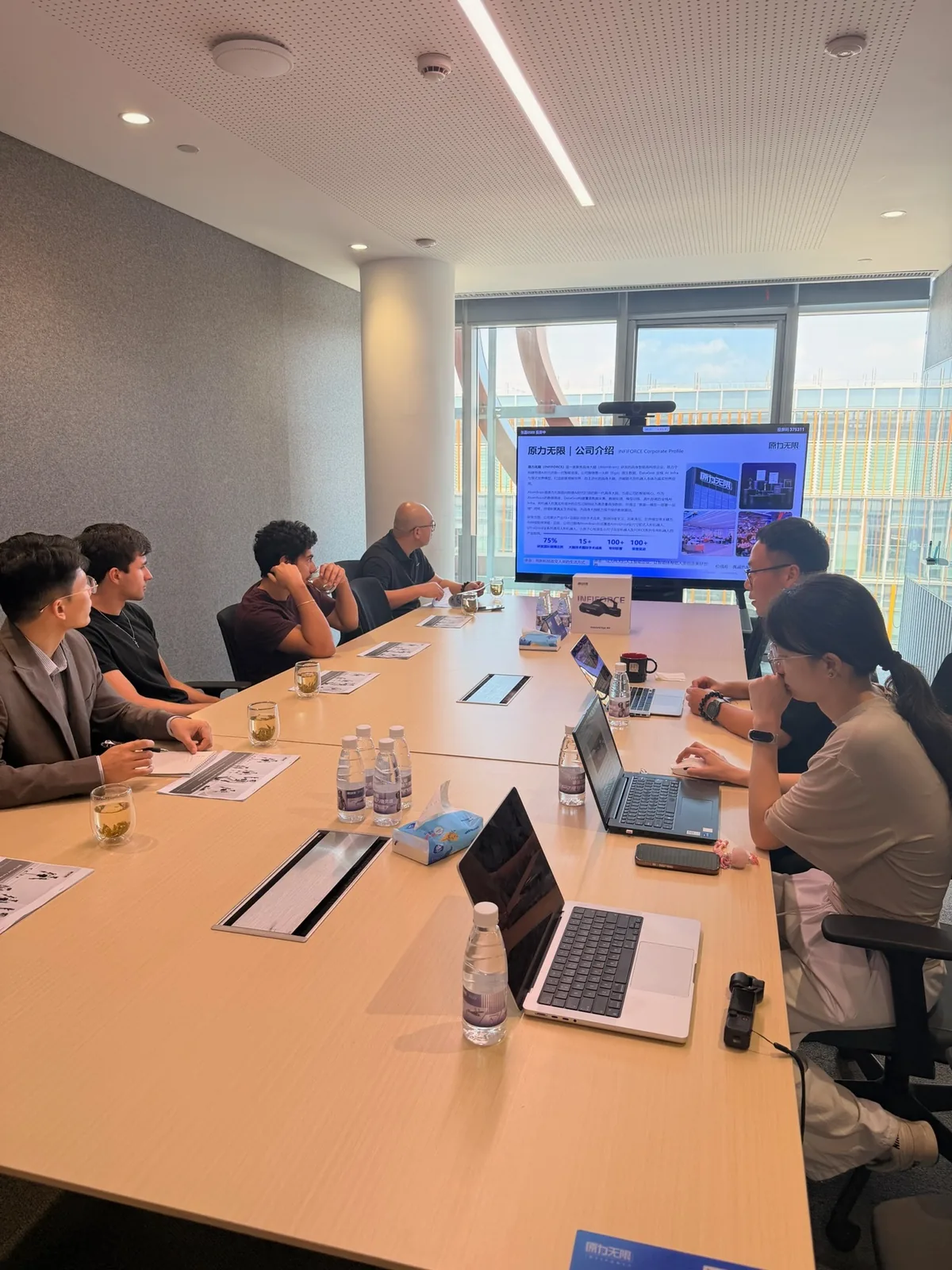
Business schools have long run China MBA study tours for their students. An executive study tour is different: it follows the company’s own questions. Most routes are built from four themes, each tied to the cities where it is easiest to see.
| Theme | Where | What leaders look at |
|---|---|---|
| Embodied AI and robotics | Hangzhou | Robot makers, AI start-ups, the city’s support for young tech firms |
| AI at industry scale | Shanghai | AI enterprises, the World Artificial Intelligence Conference, applied AI in services |
| Model labs and policy | Beijing | Large-model developers, research institutes, regulation |
| Consumers and channels | Shanghai and Hangzhou | Platform operators, retail category teams, how AI changes buying |
Hangzhou: the six little dragons and the robots
Hangzhou has become shorthand for China’s new generation of AI and robotics companies. The “six little dragons” are DeepSeek, Unitree Robotics, Game Science, DEEP Robotics, BrainCo and Manycore Tech. Four of the six are preparing stock market listings, and most recorded triple-digit growth in revenue or output last year, according to the city’s mayor (China Daily, 10 Mar 2026).
The city is building a pipeline behind them. Its Runmiao (“nurturing seedlings”) programme scores early-stage firms and backs selected ones with equity, loans and guarantees through a fund with a horizon of up to 20 years. Zhejiang province reported AI revenue of more than 710 billion yuan last year and has named 96 start-ups as “new technology dragons”, 57% of them AI firms (same source).
Foreign leaders have noticed. On 26 February 2026, German Chancellor Friedrich Merz travelled to Hangzhou with a delegation of business leaders and toured companies including Siemens Energy and Unitree (Al Jazeera). Unitree’s founder Wang Xingxing said the visit “highlights the global focus on China’s robotics industry” (CGTN via eHangzhou). For a leadership team, Hangzhou is where the speed of China’s hardware-plus-AI start-ups is easiest to see up close.
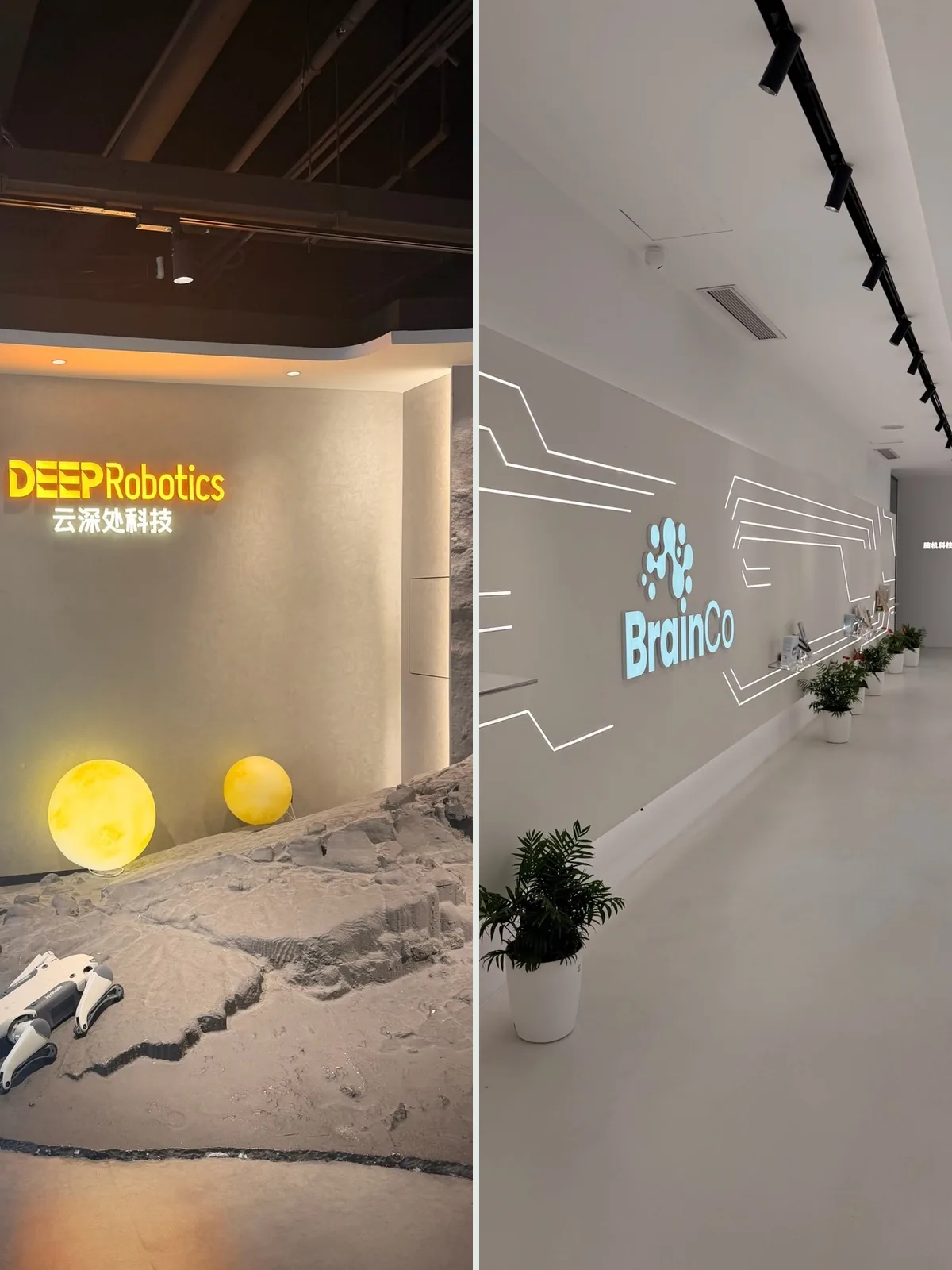
Many routes pair the robotics start-ups with visits on the platform side of China’s digital economy. Hangzhou also features on our China tech tour for investors.
Shanghai: AI at industry scale
Shanghai is where AI meets the rest of the economy. The city counted 394 major AI enterprises in 2025, with a combined scale above 637 billion yuan, up 39.5% year on year (Shanghai municipal government, 8 Jul 2026).
It also hosts the World Artificial Intelligence Conference (WAIC), now in its eighth consecutive year. The 2026 edition ran from 17 to 20 July with a record exhibition area of more than 100,000 square metres, more than 1,100 exhibiting companies, over 300 global product debuts and more than 140 forums. More than 200 companies took part in the embodied AI section alone (same source). For a team that wants to see the whole sector in a few days, it is the most concentrated week of the year.
For a market-entry team, the Shanghai leg is also where the route turns from technology to customers: consumers, channels and the platform operators that serve them.
Beijing: model labs and policy
Beijing is the policy and research end of the route. It had 183 registered large AI models by late 2025, the most of any Chinese city, and more than 2,500 AI firms. Preliminary estimates put its AI industry above 450 billion yuan in 2025 (China Daily, 26 Jan 2026). For leaders whose question is “where is regulation heading and who builds the models?”, a Beijing leg answers it more directly than any report.
The factory floor: where AI becomes cost and speed
The lesson that travels best back to a board is on the factory floor. The International Federation of Robotics counted 295,000 industrial robots installed in China in 2024, a record and 54% of global installations. China’s operational stock passed 2 million units, and Chinese suppliers took 57% of their home market, outselling foreign brands in China for the first time (IFR World Robotics 2025).
Humanoid robots are following. CNNIC reports more than 400 humanoid robot products on the market in the first half of 2026, with annual production expected to exceed 100,000 units (ECNS). Seeing these lines in person is how a leadership team calibrates what a Chinese competitor’s cost and lead time will look like in two or three years.
What leadership teams take home
A study tour is only worth the flight if it changes a decision. The outputs leaders usually come back with fall into three groups.
A calibrated view of competitors
A first-hand sense of how fast Chinese firms in your sector design, build and ship, and what that does to price and lead time in your markets.
A partner and channel shortlist
Names and conversations, not desk research. Our market-entry programme, for example, lists meetings with platform operators, retail category teams and introductions to warehousing, legal and accounting partners (China Market Entry Trip).
A board-ready decision
Enough evidence to decide whether to enter, partner, source or wait, before capital is committed.
Planning a China executive study tour for 2027
Three practical points shape every route.
Entry rules
Many European passports, including those of France, Germany, Italy and Spain, currently allow 30 days visa-free for business, but the arrangement runs until 31 December 2026 (Beijing municipal government). The UK was added from 17 February 2026 to the same end date (China-Britain Business Council). No extension had been announced as of 6 November 2026, so check before booking 2027 travel.
Timing
If seeing the whole AI sector matters, plan around WAIC in Shanghai (held in July in 2026; check the 2027 dates). Otherwise, company visits are easiest outside Chinese public holidays.
Route
Shanghai and Hangzhou are about an hour apart by high-speed train (Travel China Guide), so most routes start there and add Beijing or Shenzhen depending on the agenda. Teams focused on hardware and robotics often add Shenzhen as part of a deep-tech and AI expedition or a Shenzhen tech tour. See all Gate Kaizen expeditions.
Frequently asked questions
What is a China executive study tour?
A China executive study tour is a short, structured business trip for a leadership team. It combines company visits, expert briefings and meetings in cities such as Shanghai, Hangzhou and Beijing, so that executives see China’s AI economy, competitors and potential partners first-hand.
How is it different from a China MBA study tour?
A China MBA study tour is designed by a business school for its students and follows the school’s curriculum. An executive study tour is designed around one company’s agenda: its market, its competitors, the partners it needs to meet and the decisions its board has to make.
Which cities does a China executive study tour cover?
Shanghai and Hangzhou are the usual core for AI, platforms and consumer markets, with Beijing added for AI model labs and policy. Gate Kaizen’s market-entry route centres on Shanghai, Hangzhou and Nanjing, and Beijing can be included.
Can we visit AI and robotics companies?
Companies such as Unitree Robotics in Hangzhou have hosted foreign delegations, including the German chancellor’s in February 2026. Access always depends on each host’s schedule and is confirmed route by route.
When is the best time to go?
It depends on your goals. If you want to see the whole Chinese AI sector in one place, plan around the World Artificial Intelligence Conference in Shanghai, held from 17 to 20 July in 2026. Otherwise, company visits work best outside Chinese public holidays.
Do executives need a visa?
It depends on the passport. Many European and UK citizens can currently enter China visa-free for up to 30 days for business, but the arrangement runs until 31 December 2026. For trips in 2027, check the latest notice from the Chinese embassy in your country before booking.
Design your China executive study tour
Gate Kaizen’s China Market Entry Trip, “From Zero to One in China”, is built for family offices, private investors, brand owners and boards that want to validate a market entry before committing capital. The sample route covers Shanghai, Hangzhou and Nanjing, Beijing can be included, and every route is designed around your agenda.