A Shenzhen tech tour is the fastest way to see how China turns an idea into a product. In one city you can walk the component markets where hardware is sourced, stand next to humanoid robots built for factory work, ride in a driverless taxi and meet the platform companies that run China’s digital economy.
This article sets out what executives actually look at on a Shenzhen route built around hardware, robotics and AI, why the city earns its place at the start of a China tech tour for investors, and what to plan for: timing, entry rules and the trip from Hong Kong. It is written for founders, investors and leadership teams weighing a deep-tech and AI expedition.
Key takeaways
- Shenzhen is China’s R&D-heaviest city. R&D spending reached 6.67% of GDP, first among Chinese cities, and companies fund more than 93% of it.
- Hardware, robotics and AI share one map. The city counts more than 2,600 AI enterprises above designated size and more than 1,000 core robotics companies.
- Huaqiangbei is the supply chain at street level: 35 specialised markets, more than 115,000 businesses and about 750,000 visitors a day.
- Autonomy is already commercial. Pony.ai’s driverless robotaxi zone covered 167.4 km² by December 2025, and the city has opened 310 drone logistics routes.
- Plan entry for 2027 now. The 30-day visa-free arrangement for many European and UK passports runs until 31 December 2026; no extension had been announced as of 3 November 2026.
Why a China tech tour should start in Shenzhen
Shenzhen’s numbers explain why investors and corporate innovation teams put it first. The city’s GDP reached 3.87 trillion yuan in 2025, up 5.5%, and its average annual growth since 2020, also 5.5%, was the highest among China’s first-tier cities. Strategic emerging industries contributed 1.67 trillion yuan, or 43% of GDP, and three sectors each passed 800 billion yuan: networks and communications, software and information services, and intelligent connected vehicles (China Daily, on the city’s 2026 government work report).
The same source puts R&D spending at 245.31 billion yuan in 2024 and R&D intensity at 6.67%, with a target above 7% by 2030. Companies consistently account for more than 93% of that spending. Shenzhen makes over 10% of China’s national output in 39 industrial products, including integrated circuits, industrial robots and smartphones.
For a visiting executive, that concentration is the point: components, devices, robots, vehicles and AI platforms can all be seen in one city, on one trip.
Hardware: Huaqiangbei and the one-week product cycle
The natural first stop is Huaqiangbei, the electronics district in Futian. According to local officials quoted on the city government’s English site, it has 35 specialised markets, more than 115,000 businesses and more than one million types of components and consumer electronics. About 750,000 people visit each day, including more than 8,000 international visitors, and for most merchants foreign trade makes up over 70% of sales (Shenzhen Government Online, August 2026).
The same report gives the figures that matter to a product or sourcing team. More than 90% of the core components for a smart device can be sourced within an hour. Customised samples can be ready in as little as two days, and a new smart product can go from concept to overseas shipment in about a week. The district’s Zhipinku AI hardware centre carries more than 300 smart hardware products from over 80 Chinese brands.
For product and sourcing teams, that speed is the lesson to take home. We cover the district in more depth in inside Shenzhen’s Huaqiangbei.

Robotics: humanoids moving from demo to factory floor
Shenzhen is home to UBTECH, one of the few humanoid makers already selling into industry. Mass production of its 1.76-metre Walker S2 industrial humanoid began in November 2025, Airbus has bought Walker S2 units for its manufacturing work, and UBTECH reported 1.4 billion yuan in humanoid orders for 2025. The research firm Omdia placed it third worldwide by 2025 shipments, behind AgiBot and Unitree (Xinhua via Shenzhen Government Online).
The 2026 numbers show the shift from showroom to revenue. In the first half of 2026, UBTECH’s full-size humanoid revenue rose 1,445% to 590.3 million yuan on 921 units sold, 46.5% of group revenue (KrASIA, citing UBTECH interim results).
Robots are also visible on the street. In Longgang district, Robot Block is a street where robots make coffee, clean the pavement and perform in a robot theatre (Shenzhen Government Online). For a leadership team, the useful contrast is between these public demos and what robots do inside a working plant, which we explored in China robotics: innovation inside the factories.
AI and platforms: Tencent’s home city
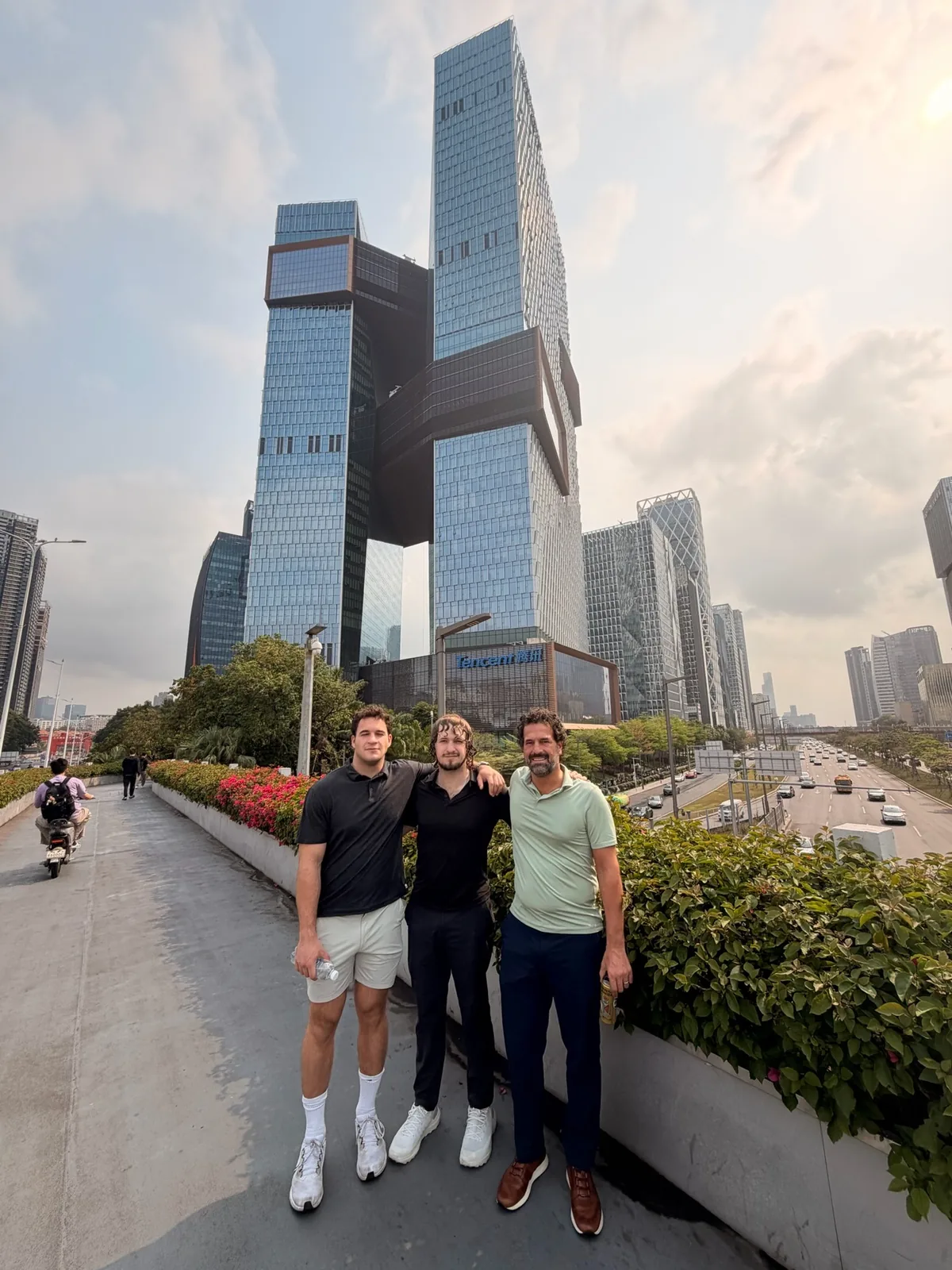
Tencent’s twin Binhai Mansion towers, 248 and 194 metres tall, stand in Nanshan district and were completed in 2017 (Wikipedia).
Tencent has hosted visiting groups for hands-on sessions. In July 2025, for example, a group of students from US universities including MIT, Stanford and Cornell explored its Hunyuan large language model in a hands-on AI workshop. The same day, the group visited the Shenzhen InnoX Academy, an accelerator that has incubated more than 140 smart hardware start-ups (Shenzhen Government Online).
The sample route on our deep-tech and AI expedition page includes a Tencent company visit and incubator sessions with founders at Tencent WeStart and Plug and Play in Shenzhen, and the page lists Tencent Cloud International among the companies our delegations have met or can add to a route. Which companies host a given group always depends on their schedule and is confirmed route by route.
Autonomous mobility and the low-altitude economy
Shenzhen is one of the few places where a visiting executive can book a driverless taxi as a normal paid ride. Pony.ai launched fully driverless commercial robotaxi services in the city in March 2025, starting in Nanshan. Its service area grew from 21.7 km² at launch to 167.4 km² by December 2025, covering core areas of Nanshan and Bao’an. The company said its Gen-7 robotaxi reached positive monthly operating profit per vehicle in Shenzhen in February 2026 (Gasgoo).
Above the streets, the city has opened 310 low-altitude logistics routes, 82 of them in 2025, and built more than 1,200 take-off and landing facilities. Shenzhen produces about 70% of China’s consumer drones and 50% of its industrial drones (Macau Business). Food delivery by drone is available in several city parks, including Shenzhen Talent Park and Shenzhen Central Park (Shenzhen Government Online).
Electric vehicles: the BYD effect
Shenzhen is also BYD’s headquarters city. The carmaker sold a record 2.26 million battery-electric vehicles in 2025, according to a company statement filed with the Hong Kong Stock Exchange (AFP via Macau Business). Intelligent connected vehicles are now one of the three Shenzhen sectors above 800 billion yuan.
For investors and suppliers, an EV stop is less about the car than the platform underneath: batteries, drivetrains and the software stack that ties them together. Seeing that hardware in person makes it easier to brief a board on how Chinese EV makers compete.
How the route fits together
Shenzhen covers about 2,000 square kilometres, so a good route groups visits by district. The table shows how the themes above map onto the city.
| Theme | Where in Shenzhen | What leaders look at |
|---|---|---|
| Hardware and components | Huaqiangbei, Futian | Component sourcing, prototyping speed, AI hardware brands |
| AI and platforms | Nanshan | Platform companies, cloud and AI model sessions, incubators |
| Robotaxis | Nanshan and Bao’an | Driverless ride-hailing in daily commercial use |
| Robotics | Longgang and company sites | Humanoid and industrial robots, public robot demos |
| Drones and low-altitude logistics | City parks and logistics routes | Drone delivery and the infrastructure behind it |
| Trade fair (late November) | Shenzhen World Exhibition & Convention Center, Bao’an | China Hi-Tech Fair: 5,000+ exhibitors expected in 2026 |
From Shenzhen, many deep-tech and AI expeditions continue to the Yangtze River Delta, where Hangzhou and Shanghai add the platform, AI-model and policy side of the story.
Planning a Shenzhen tech tour for 2027
A few practical points shape every Shenzhen route.
Arriving via Hong Kong
If you fly into Hong Kong, the high-speed rail from Hong Kong West Kowloon to Futian takes about 15 minutes (Wikipedia), which puts Huaqiangbei and the Futian business district within easy reach on arrival day.
Timing around the calendar
The China Hi-Tech Fair (CHTF) is scheduled for 26 to 28 November 2026 at the Shenzhen World Exhibition & Convention Center in Bao’an, with 400,000 m² of space and more than 5,000 exhibitors and 1,000 purchasing groups expected (CzechTrade). The 2027 dates had not been published when we checked; confirm them with the organiser before you book. For other events worth timing a trip around, see our guide to planning a China networking trip.
Entry rules
Ordinary passport holders from many European countries can currently enter China visa-free for up to 30 days, business included, until 31 December 2026 (Xinhua). UK passport holders have had the same 30-day access since 17 February 2026, also until 31 December 2026 (CBBC). China recorded 8.32 million visa-free entries by foreign nationals in the first quarter of 2026, up 29.3% year on year (Xinhua). For 2027 trips, check the latest notice from the Chinese embassy in your country.
Who it suits
Investors scouting hardware, robotics or AI companies; corporate innovation and strategy teams; product and sourcing leaders who need to see how fast Shenzhen prototypes; and leadership teams preparing a board discussion on China’s technology sector.
Frequently asked questions
What is a Shenzhen tech tour?
A Shenzhen tech tour is a structured business trip to see China’s hardware, robotics, AI and electric-vehicle industries in one city: electronics markets such as Huaqiangbei, robotics and EV companies, platform firms in Nanshan and live services such as driverless taxis and drone delivery.
How many days do I need in Shenzhen?
It depends on your goals. Shenzhen is large, covering about 2,000 square kilometres, so routes are grouped by district. Many executives combine Shenzhen with Hangzhou and Shanghai to see both the hardware and the platform side of China’s technology sector.
Can I ride a driverless taxi in Shenzhen?
Yes. Pony.ai has run fully driverless commercial robotaxi services in Shenzhen since March 2025, and by December 2025 its service area covered 167.4 square kilometres in core areas of Nanshan and Bao’an.
Is Huaqiangbei worth visiting for executives?
Yes, if hardware matters to your business. The district has 35 specialised markets and more than 115,000 businesses, and local officials say more than 90% of the core components for a smart device can be sourced there within an hour.
Do I need a visa for a business trip to Shenzhen?
It depends on your passport. Many European and UK passport holders can currently enter China visa-free for up to 30 days for business, but these arrangements run until 31 December 2026. For trips in 2027, check the latest notice from the Chinese embassy in your country before booking.
Can we visit specific companies such as Tencent or UBTECH?
Companies such as Tencent have hosted visiting groups, but access always depends on the host’s schedule and is confirmed route by route. Gate Kaizen builds each expedition around your own agenda.
Design your Shenzhen tech tour
Gate Kaizen’s China Innovation & AI Tour is built for investors and builders who need to see China’s technology first-hand. The sample route runs from Shenzhen in the Pearl River Delta to Hangzhou and Shanghai in the Yangtze River Delta, and every expedition is built around your agenda.