Reading about China’s technology from abroad gets you the headlines. A China tech tour gets you what sits behind them: how fast a hardware team iterates, how a model lab thinks, and how a district government pitches itself to foreign capital.
This guide is for investors and innovation leaders planning a China tech tour in 2026 or 2027. It covers three cities: Shenzhen for hardware and robots, Hangzhou for platforms and AI, and Shanghai for policy and capital, plus the visa and rail logistics that make a multi-city route work. Our Deep-Tech & AI expedition page shows how we build these trips.
Why investors still go in person
Access runs through institutions
The companies worth visiting do host foreign groups, but rarely through a public booking form. The 2026 visits on record (a Belgian delegation at DJI and UBTECH, more than 150 foreign companies at Alibaba and Unitree, multinational delegations in Zhangjiang) were organised or reported by city governments and investment-promotion offices. For large companies, access usually runs through chambers, investment-promotion offices or a trusted intermediary.
The story moves faster than the reports
Alibaba launched Qwen3.8-Max on August 3, 2026. Unitree listed on the STAR Market sixteen days later, and local officials have set up a separate showroom because so many visitors arrive. By the time an annual report is published, the conversation on the ground has moved on.
You see the gritty side, not just the showroom
The most useful hours are often the least polished: incubator floors, founder sessions, a factory line, a district official explaining what the city wants. On our most recent deep-tech expedition, the programme included 5 company and ecosystem visits, 8 founder and startup sessions, 3 startup incubators and 1 high-profile government meeting. For automation up close, see China robotics inside the factories.
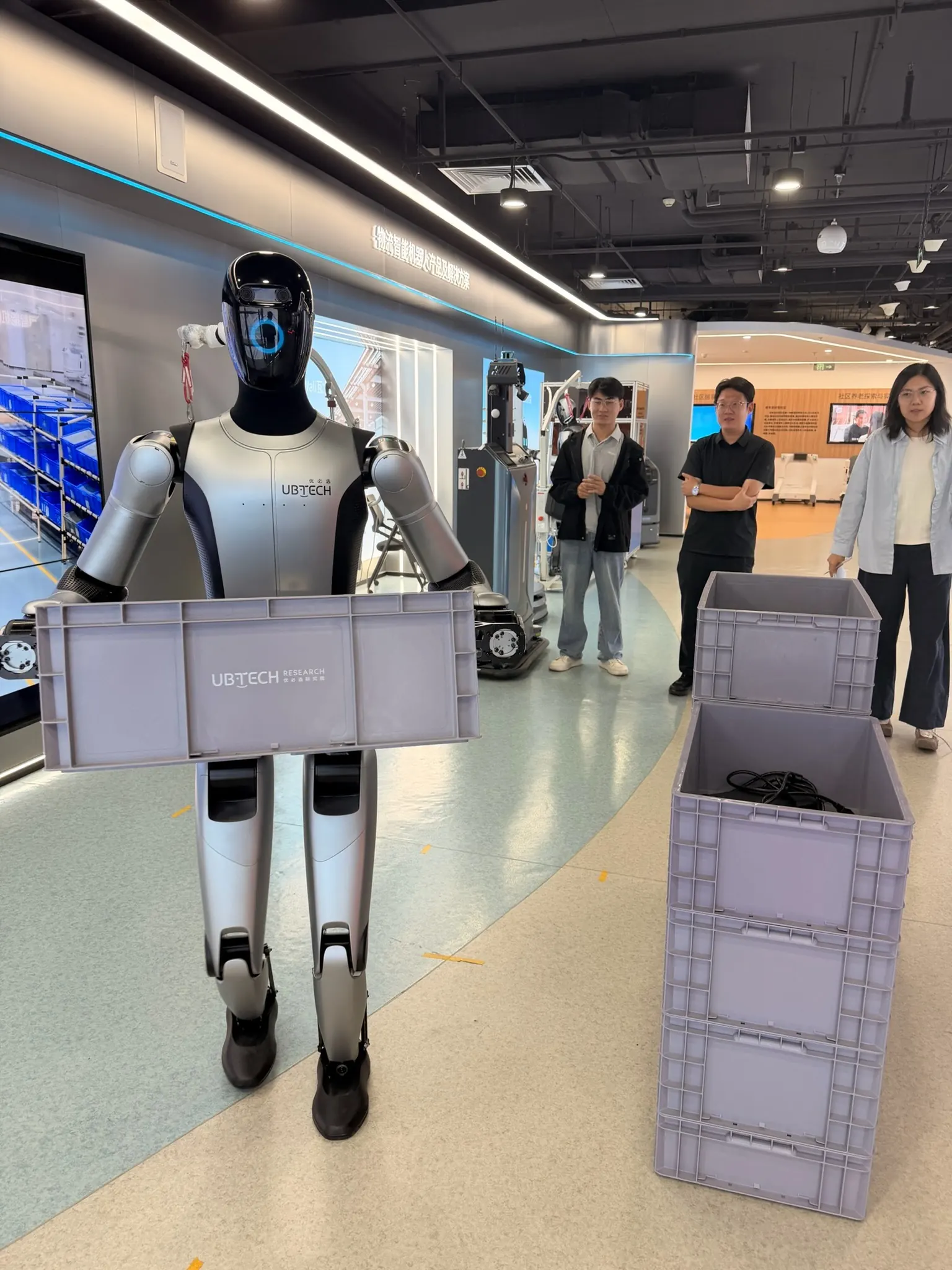
A UBTECH humanoid robot demonstrating warehouse tasks for a Gate Kaizen delegation
Shenzhen: hardware and robots
A Shenzhen tech tour is about physical products: drones, humanoids and the supply chain that turns a prototype into something shipped at scale.
DJI
DJI was founded in 2006 by Frank Wang (Wang Tao) and has its “Sky City” headquarters in Shenzhen. It makes drones and imaging products, and has moved into robotics and home devices. In April 2026, DigiTimes reported that DJI’s revenue had topped US$11 billion.
UBTECH Robotics
UBTECH was founded in March 2012, is headquartered in Nanshan and has been listed in Hong Kong (9880.HK) since December 29, 2023. It builds humanoid and service robots, including the Walker S industrial humanoids. According to the company, mass production and delivery of the Walker S2 began in 2025. In 2026 it launched Walker C1 and UWORLD U1, and by June 2026 it held 3,112 granted patents.
In March 2026, DJI, UBTECH and Dobot together hosted a Belgian business delegation in Nanshan District. The visit ended with a matchmaking conference at the “Go Global” Global Service Center (Shenzhen Government Online).
Incubators and the hardware street
A 2026 local guide lists Shenzhen Foundry and TroubleMaker’s Conquer! (in Huaqiangbei) among the city’s active hardware incubators, with XbotPark’s robotics base at Songshan Lake in neighbouring Dongguan. Past Gate Kaizen routes have included incubator visits at Tencent WeStart and Plug and Play, plus a half-day Huaqiangbei workshop where participants build their own iPhone. Our guide to Shenzhen’s Huaqiangbei electronics market explains why it matters.
A note on EHang
EHang is often grouped with Shenzhen, but its headquarters is in nearby Guangzhou. It builds the EH216-S pilotless passenger eVTOL, and in March 2025 its operators received China’s first Air Operator Certificates for pilotless passenger eVTOLs (EHang IR). Plan it as a Guangzhou stop on a Pearl River Delta route.
Investor takeaway: in Shenzhen, DJI and UBTECH host foreign delegations, and a visit can end in structured matchmaking. Bring questions about production, not just product.
Hangzhou: platforms and AI
Hangzhou is where a China AI innovation tour gets concrete. On April 23–24, 2026, a group of more than 150 foreign companies from the US, South Korea, France, the UK and Canada visited Alibaba’s Xixi campus, Cainiao’s headquarters, an embodied-AI robotics town, Unitree and China Biopharma Town (ehangzhou.gov.cn).
Alibaba Cloud and Qwen
Alibaba Cloud launched in September 2009 and provides cloud and AI infrastructure. Qwen is its family of large language and multimodal models. Qwen3.8-Max, announced from Hangzhou on August 3, 2026, is a 2.4-trillion-parameter mixture-of-experts model with 95 billion active parameters and a one-million-token context window, available by API on Model Studio. For how Qwen compares with ByteDance’s and Baidu’s models, read Inside China’s AI Model Race.
Unitree Robotics
Unitree was founded in 2016 by Wang Xingxing and is based in Hangzhou’s Binjiang district. It builds quadruped and humanoid robots. It listed on the STAR Market on August 19, 2026, at ¥150.80 a share. It closed its first day at ¥845 and raised ¥6.1 billion (BBC; Caixin Global). It had 516 staff at the end of 2025 (ezhejiang.gov.cn).
BrainCo
BrainCo was founded in 2015 by Han Bicheng and develops non-invasive brain-computer interfaces and bionic hands and legs. In January 2026 it was reported to have filed confidentially for a Hong Kong IPO, with CICC and UBS, after a reported ¥2 billion round co-led by IDG Capital and Walden International (China Daily HK).
Past Gate Kaizen routes in Hangzhou have included BrainCo, Alibaba and the Hangzhou Robot Experience Centre. On our October 2026 AI expedition, the group also met robotics company INFIFORCE.
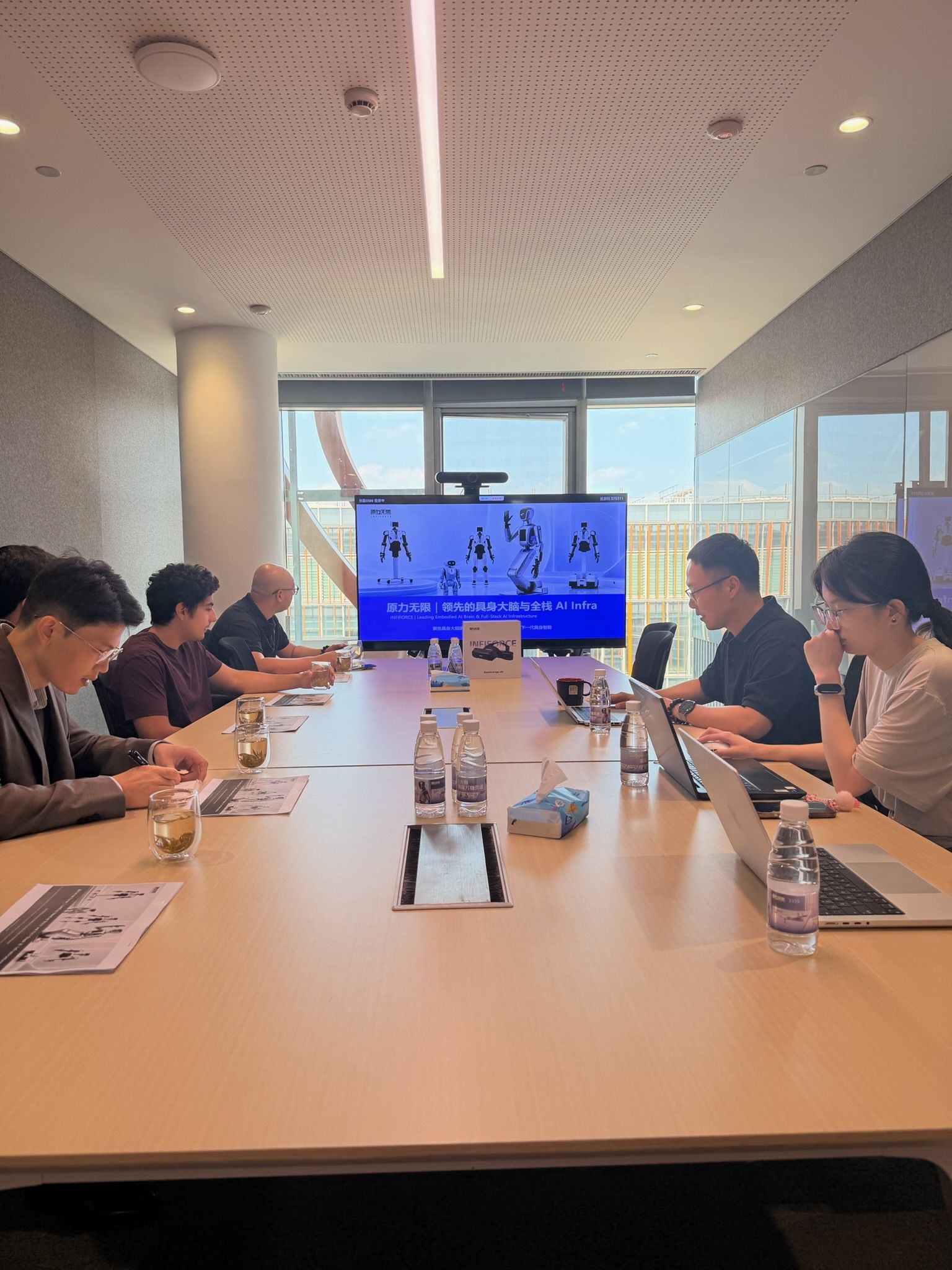
Meeting with INFIFORCE, Hangzhou
Investor takeaway: Hangzhou puts a frontier model lab, a newly listed robot maker and a brain-computer interface company within one city.
Shanghai: policy and capital
If Shenzhen shows how things are built and Hangzhou how platforms scale, Shanghai shows how the state and capital set the stage.
Zhangjiang AI Innovation Town
Zhangjiang AI Innovation Town in Pudong hosted a “Multinational Companies Shanghai Tour” on September 18, 2026, with delegations from the UK, Germany, France, Japan and Korea. They saw the AI Application Store, Zhangjiang Robot Valley and Pharma Valley. The tour was organised through the Shanghai Investment Promotion Office, Pudong’s investment-promotion office and Zhangjiang Group (Shanghai government). For an investor, the organiser list is the point: in Shanghai, investment-promotion offices are often the hosts.
Policy in the room
Our last deep-tech expedition included a meeting with the Shanghai Jing’an District Mayor, covering government policy for foreign direct investment and local innovation support. The route also included a discussion with foreign tech entrepreneurs in Shanghai and a Hongqiao CBD incubator visit. On our October 2026 AI expedition, the delegation also toured SenseTime’s AI exhibition hall.
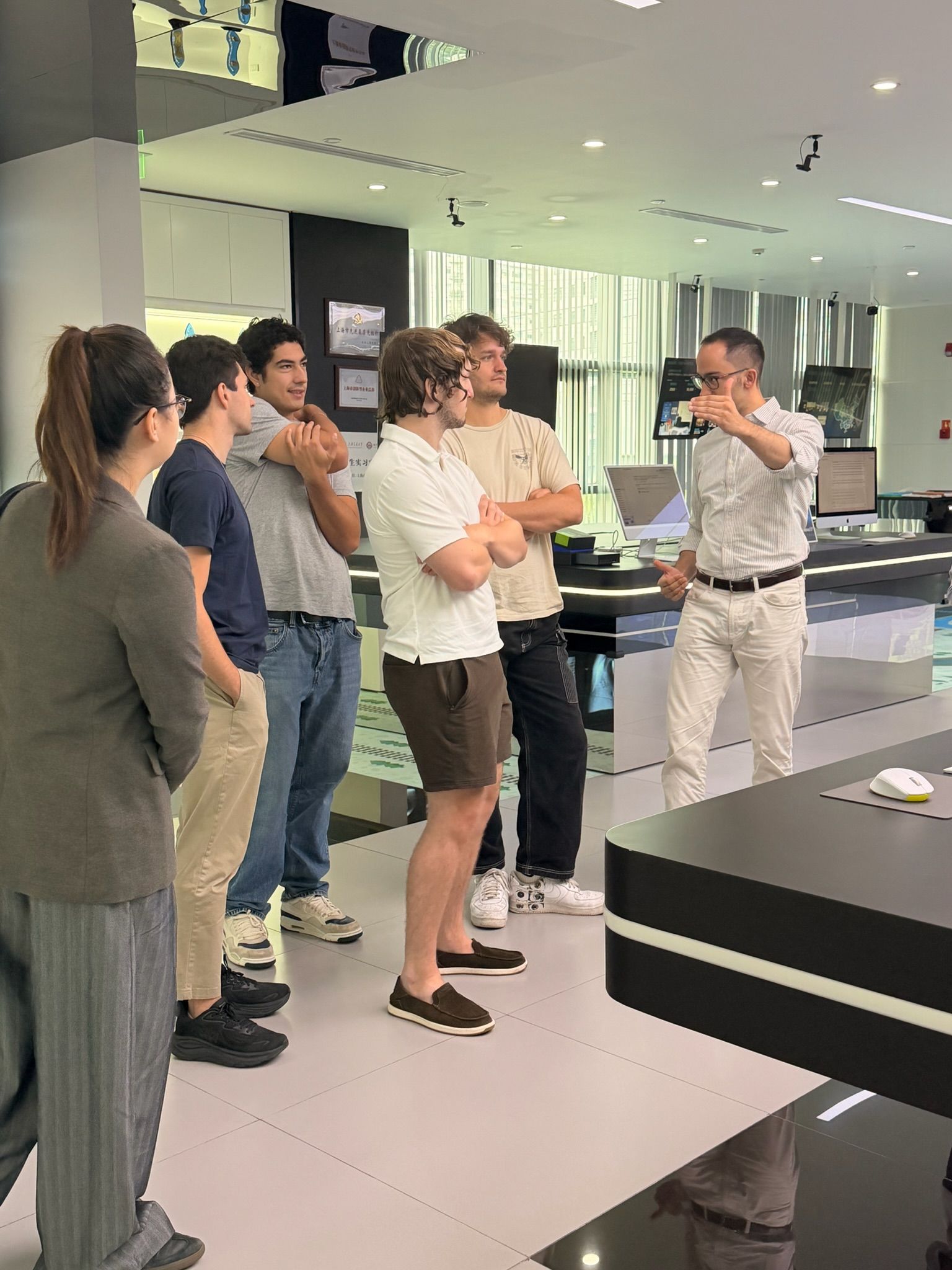
Touring the SenseTime AI exhibition hall, Shanghai
Investor takeaway: Shanghai is where you hear how government wants foreign capital to engage. Bring questions about support schemes and local partners.
Visas and rail logistics for a China tech tour in 2026
Entry rules (as of October 2026)
- Most EU countries: 30 days visa-free until December 31, 2026, including for business. The 30 days count from the day after entry. The list covers 25 of the 27 EU states. Czech and Lithuanian passport holders are not on it and need the 240-hour transit option or a visa (visaforchina.cn). If you are planning 2027 dates, check whether the scheme has been extended.
- Singapore: 30 days mutual visa-free since February 9, 2024, under a bilateral agreement with no end date (ICA).
- United States: no 30-day visa-free entry. US citizens need a visa or can use the 240-hour (10-day) visa-free transit. This needs an ordinary passport, a confirmed onward ticket to a third country or region, and entry through one of 65 eligible ports in 24 provinces. Business activities are allowed; work, study and journalism are not. It covers 57 countries (NIA).
- India: a visa is required. Apply online, then submit in person; from October 26, 2026, the Embassy in New Delhi and the Consulate in Mumbai accept applications directly. Regular processing takes 7 working days. Reduced fees run to December 31, 2026 (Rs2,900 single entry) (Chinese Embassy in India).
For the 240-hour route, Shanghai Hongqiao, Shanghai Pudong, Hangzhou Xiaoshan and Shenzhen Bao’an are all eligible ports. The permitted area includes all of Shanghai, Zhejiang and Guangdong, and travel between those provinces is allowed. That means a Shanghai-in, Shenzhen-out route works for eligible passports, as long as the onward ticket goes to a third country or region. Under every visa-free scheme, entry is still the border officer’s decision, so carry your invitation letter, onward tickets and hotel bookings (Beijing FAO). On our expeditions, the visa invitation letter and on-arrival assistance are included.
High-speed rail between the three cities
- Shanghai Hongqiao to Hangzhou East: about 34 minutes on the fastest trains; most G trains take about 45–60 minutes.
- Hangzhou to Shenzhen: about 5h47m to 6h21m on G trains.
- Shanghai Hongqiao to Shenzhen North: 6h34m on G269/G270 since July 1, 2026, down from 7h14m (Shenzhen Daily).
Shanghai and Hangzhou work as one corridor. The leg to Shenzhen is most of a day by train, so plan it as a travel day, and check exact trains on 12306.
How Gate Kaizen builds a bespoke China tech tour
Most China innovation tours sell fixed dates and a fixed company list. We start from your investment thesis. A typical deep-tech route runs from the Pearl River Delta to the Yangtze River Delta: hardware, then platforms, then policy.
- Strategic brief. We map your objectives, target sectors, companies and the decisions the trip has to inform.
- Tailored agenda. We pre-screen and schedule the companies, founders, factories and officials that match your brief.
- On the ground. Senior bilingual guides, technical interpreters and all logistics, including 4-star hotels and domestic high-speed trains, flights and vans, so your team can focus on the meetings.
- Follow-through. Verified contacts, structured takeaways and introductions to keep the relationships moving afterwards.
Our deep-tech expeditions are built for venture capital and growth investors, corporate venture and innovation teams, deep-tech, AI and robotics founders, and CTOs. For other tracks, see all our China business expeditions.
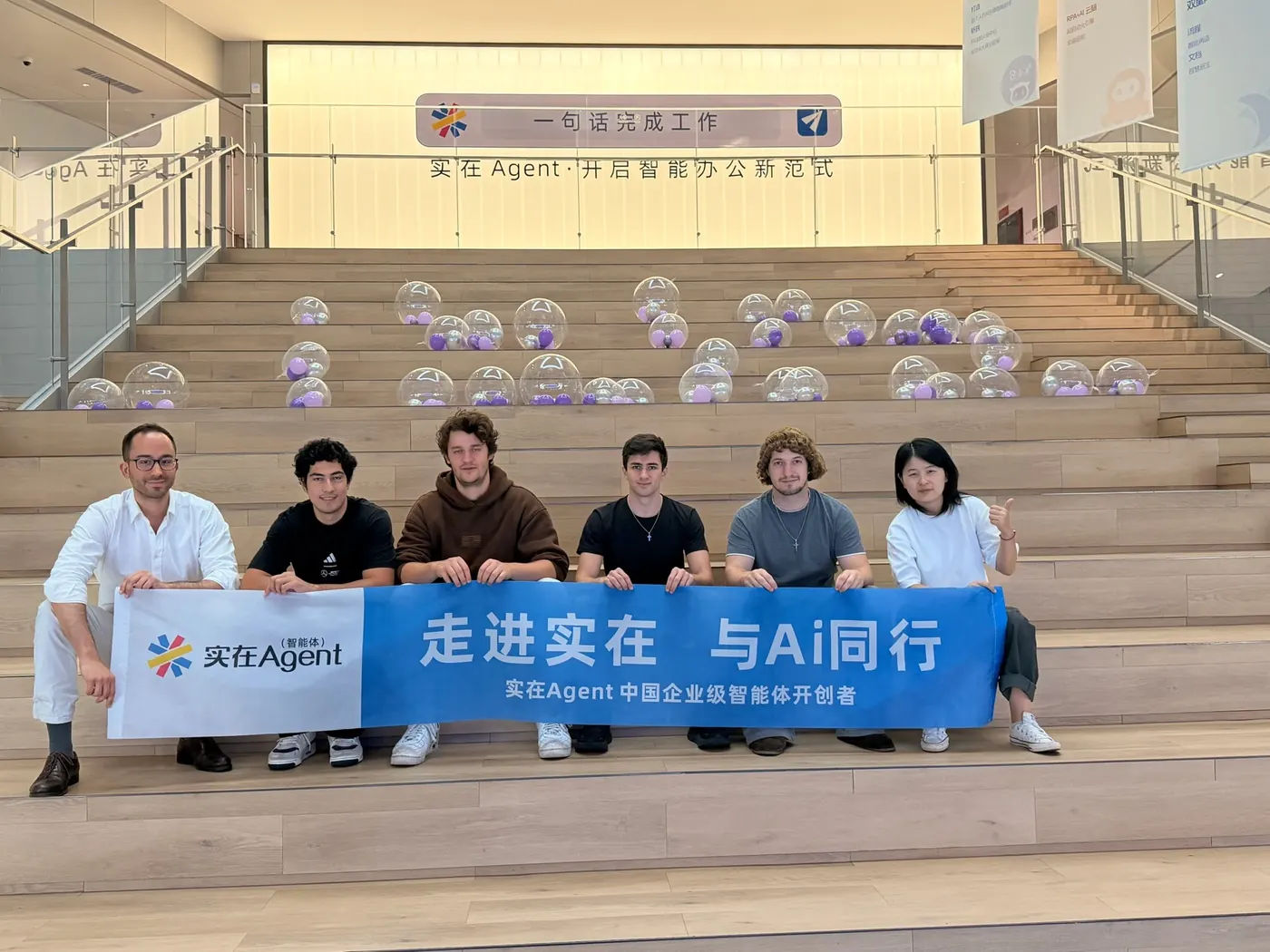
A Gate Kaizen deep-tech and AI delegation in China
Tell us your thesis, the cities you have in mind, your dates and your group size. We will come back with a draft route.
Write to us at hello@gatekaizen.com or send an enquiry through our Deep-Tech & AI expedition page.
Enquire about a Deep-Tech & AI expedition