The 140th Canton Fair opened in Guangzhou on 15 October and runs until 4 November 2026. It is the fair’s 70th anniversary session.
Two of its three phases have now closed, and the official numbers say more than the usual “record attendance” headline. I am writing this on 27 October 2026, the day Phase 2 closed.
Key takeaways
- Phase 1 drew 189,000 overseas buyers from 214 countries and regions, up 13.3% and a record for that phase.
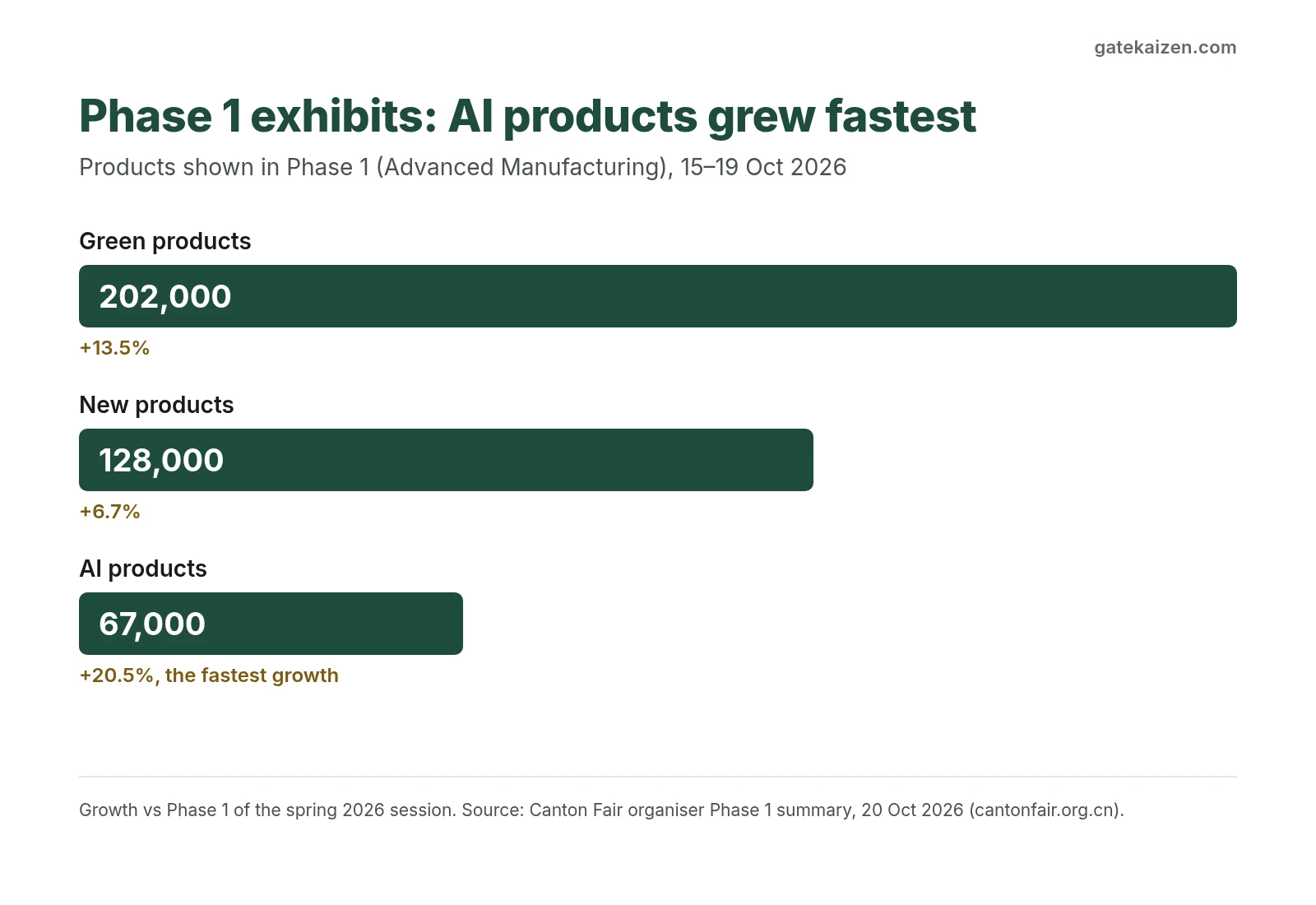
- AI products grew fastest: 67,000 in Phase 1, up 20.5%.
- CCTV reported 278,000 overseas buyers as of 17:00 on 27 October, up 13.4%. Final figures come after 4 November.
- Exhibitors are selling solutions: 36.5% now run a product-plus-service model.
- Many buyers are taking their visits from the halls to factories across the Pearl River Delta.
- Spring 2027 dates are unconfirmed, and visa-free entry for 48 countries is set to end on 31 December 2026.

The 140th Canton Fair at a glance
The official pre-fair figures set the scale. Here are the ones that matter most for buyers.
| Item | Figure | Source |
|---|---|---|
| Dates | Phase 1: 15–19 Oct Phase 2: 23–27 Oct Phase 3: 31 Oct – 4 Nov 2026 |
Canton Fair |
| Phase themes | Advanced Manufacturing; Quality Home Life; Better Life | Canton Fair |
| Exhibition area | 1.55 million m² | Canton Fair |
| Exhibitors | More than 32,000, of which more than 11,000 “high-quality” firms | Ministry of Commerce via Xinhua |
| Expected overseas buyers | About 340,000 | People’s Daily |
| New and green products | 23.2% and 26% of exhibits, both record shares | Ministry of Commerce via Xinhua |
| Exhibitors using industrial internet or AI | About 64% | Ministry of Commerce via Xinhua |
| Exhibitors with a “product plus service” model | 36.5% | Ministry of Commerce via Xinhua |
Phase 1: advanced manufacturing, and a lot of AI
Phase 1 ran from 15 to 19 October. It covered electronics, appliances, machinery, automation, vehicles, new energy, lighting and hardware.
The organiser’s Phase 1 summary (in Chinese) and China Daily report:
- 189,000 overseas buyers from 214 countries and regions, up 13.3% on the same phase of the spring session
- more than 12,000 exhibitors, over 6,000 of them classed as high-quality firms
- 128,000 new products (up 6.7%), 67,000 AI products (up 20.5%) and 202,000 green products (up 13.5%)
- 58 global top purchasers joining the fair’s buyer alliance
- 362,000 people using the fair’s app, and the fair’s first international medical services zone, with 19 medical institutions
A dedicated robot zone
The fair also set up a Service Robots zone of 4,200 m² in the Friendship Hall (21.2), according to Guangzhou Daily citing the organiser. It showed full-size humanoids, tactile dexterous hands, wheel-legged robots, inspection robots and automated coffee kiosks.
The organiser’s summary names companion robots and bionic dexterous hands among the AI products on show.
My reading: question the AI label
The 20.5% jump in AI products is the number to watch, but also the number to question. “AI product” on a booth sign covers everything from a robotic hand to an ordinary appliance with a voice or camera module added.
Both can be good business, but they are different purchases. Before the price list, I would ask four questions:
- Whose model runs it?
- Who makes the module?
- What still works when the cloud connection drops?
- Who supplies parts and updates in three years?
Phase 2: home, gifts and building materials
Phase 2 closed today, 27 October, under the theme “Quality Home Life”. CCTV’s figures, as carried by Wen Wei Po and Yicai (both in Chinese):
- 278,000 overseas buyers from 218 countries and regions as of 17:00 on 27 October, up 13.4% on the same period of the previous session
- 152 overseas business organisations and 384 leading purchasing companies attending as groups
- 515,000 m² and more than 25,000 booths across 14 sections
- about 11,000 export exhibitors, including more than 3,600 high-quality firms (up about 7.6%)
- 2.376 million products: 24.2% new, 26.9% green and 25.0% with the exhibitor’s own intellectual property
- 178 product-launch events, with about 15% more launches than the previous session
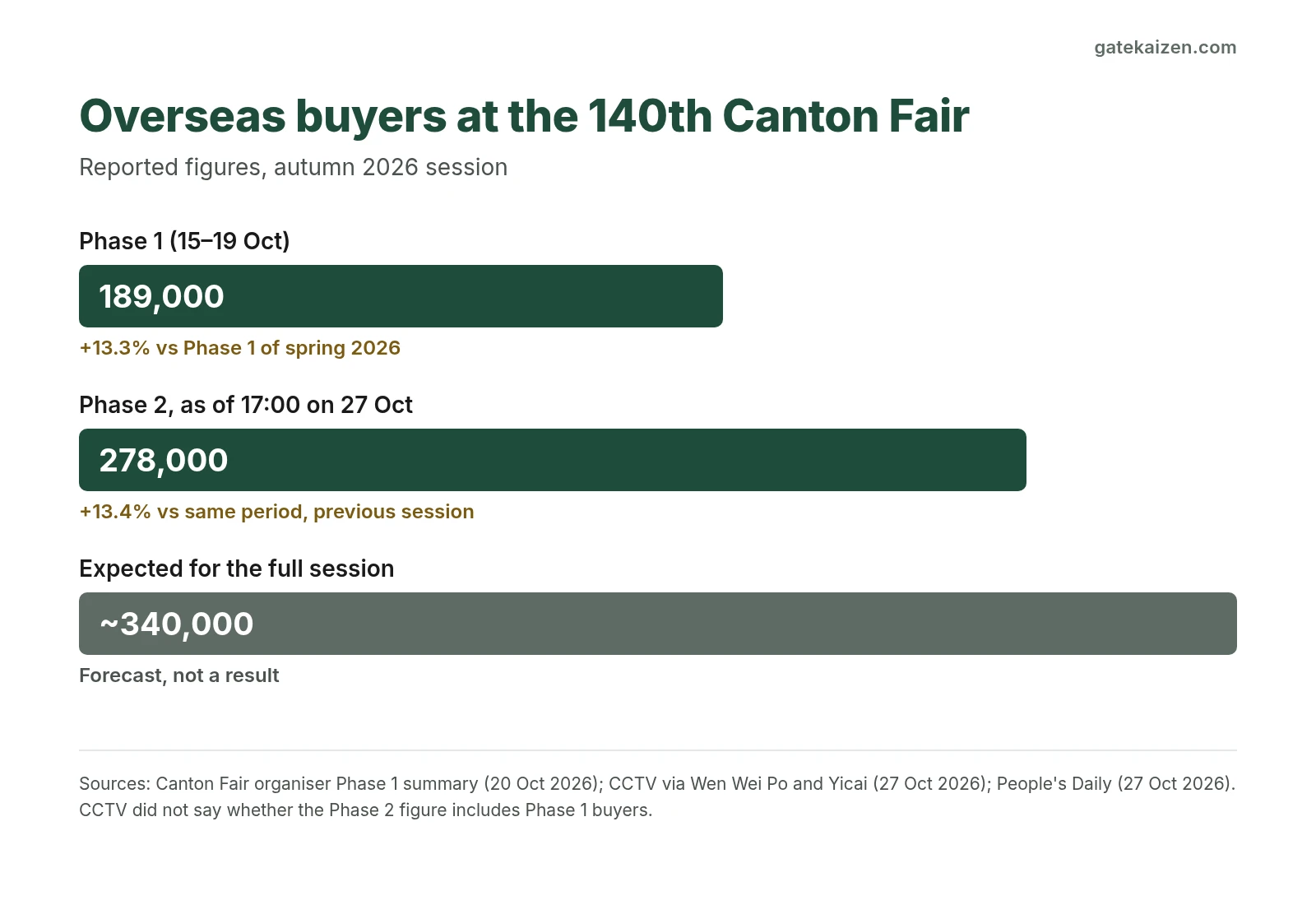
The report does not say whether 278,000 counts Phase 2 alone or the whole session to date. Set against Phase 1’s 189,000, I read it as a running total. Wait for the organiser’s closing figures before quoting it either way.
What one exhibitor saw
A Dongguan furniture exhibitor told local media that fewer visitors were simply comparing prices. Buyers looked harder at compliance certifications (it cited EU rules such as EUDR and PPWR), full-set supply capability, quality and delivery stability.
Many, it said, booked factory visits for after the fair. That is one company’s view, not data, but it matches the trend below.
Phase 3: what to watch from 31 October
Phase 3 runs from 31 October to 4 November under the theme “Better Life”. It covers toys and baby products, fashion, home textiles, stationery, and health and recreation (CCTV via Wen Wei Po). No results exist yet.
If you are in those categories, look at the share of new and own-IP products. It has been above 23% in the official figures for the session and for Phase 2. Look too at how exhibitors answer EU and US compliance questions.
What it means for Western buyers and executives
1. The fair is selling solutions, not just products
The organiser’s Phase 1 summary describes the shift as moving “from selling products to selling solutions”. The Ministry of Commerce says 36.5% of exhibitors now run a product-plus-service model, and the fair covered 10 categories of producer services for the first time.
For a buyer, more suppliers can now offer design, compliance and logistics alongside the product. It also means more to verify. A bundled offer is only as strong as its weakest subcontractor.
2. Buyers are leaving the halls for the factories
The most useful article of the session, for me, was not a results release. On 27 October, People’s Daily reported that many buyers were taking their visits beyond the fairgrounds to factories across the Pearl River Delta, touring production lines, examining supply chains and discussing joint R&D.
That has been my view for years. The booth is a sales office. Only a site visit shows you capacity, process control, raw-material stock, and whether you are dealing with a manufacturer or a trading company.
3. More buyers, from more places
Attendance rose 13% or more in both phases and now spans 214 to 218 countries and regions. The releases do not give a country breakdown, so I will not guess at one.
The practical point for a European or North American buyer: you are not the only demand these suppliers are chasing. Capacity at good suppliers is finite, and in my experience their attention goes to the buyers who show up in person.
4. The AI and robotics wave is real, and uneven
67,000 AI products in one phase, a dedicated robot zone and record new-product shares are not noise. They show how fast embedded AI is moving into everyday products.
For executives, it is a reason to see the factories behind those products, not just the demos. For a wider view, see why China’s manufacturing system moves faster.
Looking ahead: spring 2027 and beyond
Four things to settle before you book: dates, visas, badges, and how to fit factory visits around the phases. Our Canton Fair 2027 buyer trip guide covers each one in detail.
Dates
The 141st session (spring 2027) has no official dates yet. If the spring 2026 pattern holds, it will run 15–19 April, 23–27 April and 1–5 May 2027.
In 2026 the gap days were 20–22 and 28–30 April. Hold refundable bookings until cantonfair.org.cn confirms.
Visas
The 30-day visa-free entry for 48 countries, including Spain, France, Germany, Italy, the UK and Canada, is set to run until 31 December 2026, according to the Ministry of Foreign Affairs.
No extension had been published as of today. The fallbacks:
- 240-hour visa-free transit. It covers 57 countries, including the US. You need a confirmed onward ticket and a designated port, and the stay is capped at 10 days (National Immigration Administration).
- A visa backed by the fair’s invitation letter. You generate it in the Buyer Service System (official guide).
Badges
Pre-registration is open year-round. Badge applications, replacements and renewals are free, and a valid badge from a previous session still works (Badge Guide).
Pairing the fair with factory visits
Use one phase to build a shortlist and the gap days to visit the top candidates in Guangzhou, Foshan, Dongguan or Shenzhen.
G trains from Guangzhou South reach Shenzhen North in as little as 29 minutes (published schedule).
If you have not visited Chinese factories before, start with our guide to visiting Chinese factories. Phase 1 electronics buyers should also leave half a day for Huaqiangbei.
FAQ
When is the Canton Fair 2026?
The 140th session runs from 15 October to 4 November 2026: Phase 1 15–19 October, Phase 2 23–27 October and Phase 3 31 October – 4 November.
How many buyers attended the Canton Fair 2026?
Phase 1 drew 189,000 overseas buyers from 214 countries and regions. CCTV reported 278,000 as of 17:00 on 27 October. About 340,000 were expected, and final figures will come after Phase 3 closes on 4 November.
What were the main trends at the 140th Canton Fair?
Record shares of new and green products, 67,000 AI products in Phase 1 (up 20.5%), a dedicated Service Robots zone, and more exhibitors offering product-plus-service packages.
When is the next Canton Fair?
The 141st session in spring 2027. Dates are not officially published. The 2026 pattern points to 15 April – 5 May 2027.
Do I need a visa for the Canton Fair 2027?
Check closer to the date. The 30-day visa-free policy for 48 countries currently runs until 31 December 2026. The alternatives are 240-hour transit or a visa backed by the fair’s invitation letter.
Join our sourcing and factory-visit expedition
Turn a fair visit into supplier decisions. Our sourcing and industrial expedition is built for buyer groups and procurement leaders: walk pre-screened factory floors, meet owners directly, and leave with multiple qualified suppliers. Every route is bespoke, designed around your own agenda.