Everyone says: “You should visit factories in person before doing business in China.”
That advice is correct. But almost nobody explains the WHY.
Most first-time China sourcing trips become chaotic very quickly. Factories are spread across multiple cities, suppliers stop replying after the initial enthusiasm, translation becomes a problem, and companies end up wasting entire days in transport. In many cases, executives discover that the supplier they have been speaking with is not even the real manufacturer.
In 2026, factory visits are still one of the most valuable things a founder, sourcing manager, or executive can do when evaluating suppliers in China, but only if the trip is structured correctly.
Why Factory Visits Still Matter in 2026
Despite Alibaba, AI sourcing tools, Zoom calls, and supplier directories, if you are serious about your supply chain development, you should still visit suppliers physically.
The reason is simple: many of the most important signals cannot be understood remotely.
Production organization, operational discipline, quality control standards, factory culture, communication dynamics, management professionalism, and ecosystem integration are all things that become obvious once you step inside a manufacturing facility.
A supplier can look extremely professional online and still be completely unsuitable operationally.
Even more important than that, China is also a highly relationship-driven business environment. Responsiveness, seriousness, and long-term alignment are often evaluated face-to-face rather than through email exchanges.

Step 1: Define Exactly What You Need Before Flying to China
One of the biggest mistakes companies make is traveling to China without a precise sourcing objective, pre-alignment conversations, supplier pre-selection and cluster identification.
Before organizing any factory visit, companies should clearly define their product specifications, expected order volumes, quality standards, certifications, packaging requirements, customization needs, and expected timelines.
Without this clarity, supplier meetings become vague and difficult to evaluate. It also becomes almost impossible to compare factories properly.
If you are still at the beginning of the sourcing process, we recommend first reading our complete China sourcing guide.
Step 2: Choose the Right Manufacturing Region in China
China is not one single manufacturing ecosystem. Different regions specialize in completely different industries, and understanding those industrial clusters is essential before planning any sourcing trip.
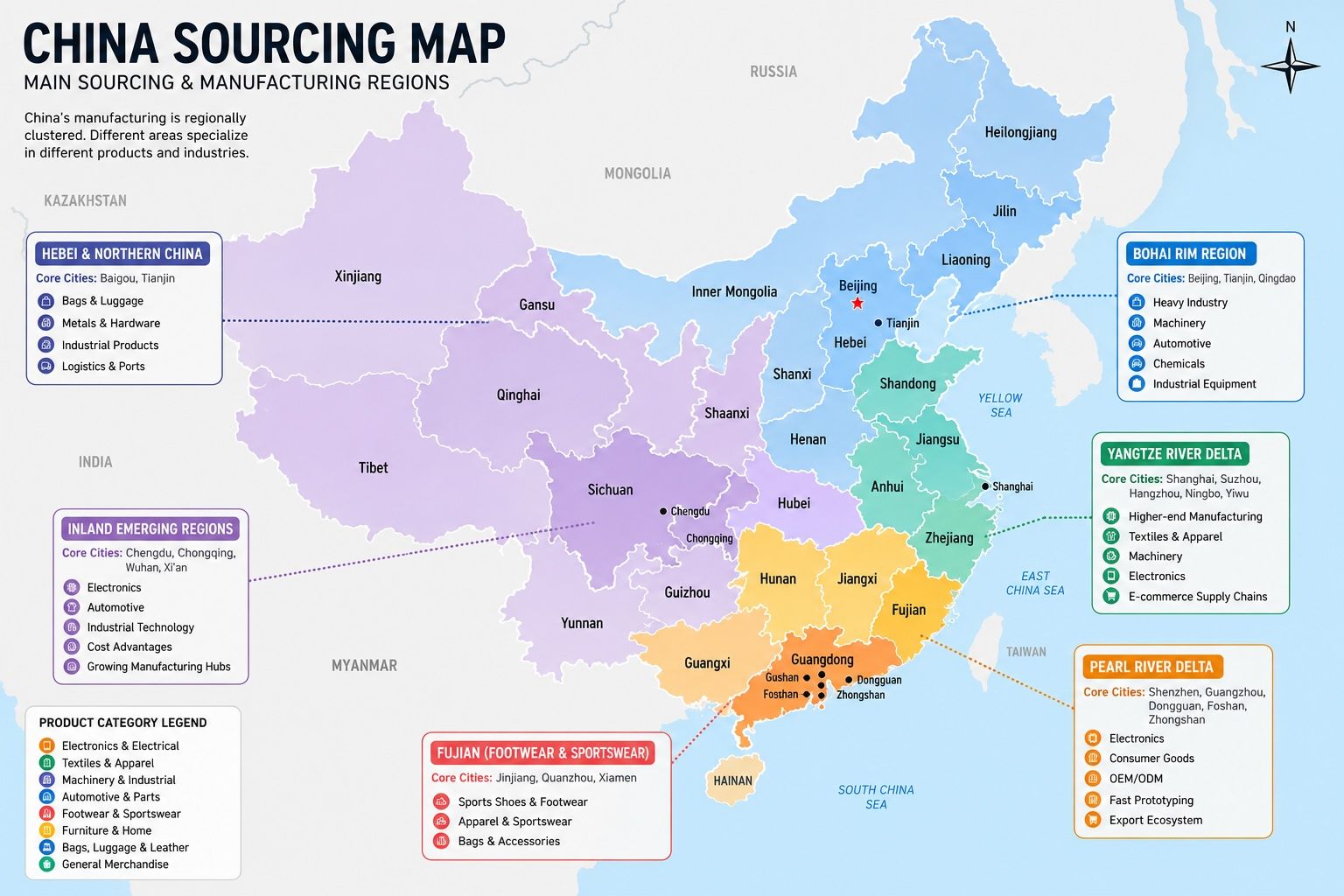
Shenzhen & Dongguan
Electronics, hardware, IoT devices, PCB manufacturing, rapid prototyping and consumer tech ecosystems.
Guangzhou & Foshan
Furniture, lighting, appliances, construction materials and large-scale industrial manufacturing.
Yiwu
Commodity sourcing, wholesale products, low-MOQ supply chains and trading ecosystems.
Shanghai & Suzhou
Industrial manufacturing, automotive, medtech and advanced technology production.
One of the most common mistakes first-time buyers make is attempting to visit factories across multiple unrelated regions during one short trip.
China is much larger than most foreign executives initially imagine. Proper regional planning is essential.
Step 3: Verify Whether the Supplier Is the Real Factory
Many companies believe they are speaking directly with manufacturers when they are actually dealing with trading companies, intermediaries, sourcing offices, or resellers.
This is not necessarily a problem, but companies should understand exactly who they are dealing with.
During a factory visit, experienced sourcing professionals evaluate production lines, machinery ownership, worker scale, warehouse operations, quality control systems, certifications, and export history.
Real manufacturers usually answer operational questions very differently from intermediaries.

Step 4: Understand the Logistics Reality of China Business Trips
This is where most DIY sourcing trips become inefficient.
Even experienced executives often underestimate transportation times, scheduling complexity, language barriers, and coordination requirements inside China.
A poorly organized trip usually results in only a few factory visits, excessive transportation costs, fragmented meetings, and low-quality supplier selection.
For a typical 6–8 day sourcing trip, companies frequently spend between $8,000 and $15,000 once flights, hotels, translators, transportation, and operational inefficiencies are included.
The larger cost, however, is usually strategic. Choosing the wrong supplier can create quality problems, delays, inventory issues, and long-term operational risks.
Step 5: Understand Chinese Business Culture During Supplier Visits
Western executives often approach supplier visits too transactionally.
In China, long-term business relationships still matter enormously. Factories are not only evaluating your order size. They are also evaluating whether you are serious, reliable, long-term oriented, and operationally competent.
Many of the most important discussions happen informally during dinners, transportation, or after the official meetings have ended.
Understanding Chinese negotiation dynamics is therefore critical.
Step 6: Evaluate More Than Just Price
The cheapest supplier is often the most expensive supplier long term.
Good supplier relationships depend on communication quality, operational transparency, flexibility, technical understanding, responsiveness, and long-term compatibility.
Experienced sourcing operators evaluate how factories solve problems, communicate delays, adapt production, and handle quality issues under pressure.
These things are almost impossible to understand purely through email exchanges.
Why Most Companies Waste Months Trying to Do This Remotely
Many sourcing teams spend six to twelve months comparing spreadsheets, emailing suppliers, and trying to understand Chinese manufacturing ecosystems remotely.
The problem is usually not lack of information.
The problem is lack of context.
China’s manufacturing advantage comes from ecosystem density.
Once executives physically experience Shenzhen supply chains, Huaqiangbei electronics markets, industrial clusters, and factory ecosystems directly, the logic behind China’s manufacturing dominance becomes much clearer.
Reading about China and experiencing China are two completely different things.

The Shortcut: Structured China Business Expeditions
This is exactly why we created our China business expeditions.
Instead of spending months organizing fragmented supplier visits independently, participants join a structured ecosystem experience combining factory visits, supplier meetings, innovation ecosystem exposure, logistics coordination, translation support, and corporate visits.
Depending on the expedition focus, participants may visit Shenzhen hardware ecosystems, Huaqiangbei electronics markets, industrial parks, manufacturing facilities, and major innovation environments across China.
The objective is not tourism.
It is compressing months of fragmented learning into one high-density business experience.
Interested in Seeing China’s Manufacturing Ecosystem Firsthand?
Our executive China expeditions include pre-vetted factory visits, supplier introductions, innovation ecosystem tours, logistics coordination, translation support, and corporate innovation visits.
See Upcoming China ExpeditionsFinal Thoughts
The companies that understand China best are usually not the ones with the best spreadsheets.
They are the ones that visited factories personally, built relationships on the ground, understood ecosystems directly, and saw how manufacturing actually operates inside China.
That experience changes how companies negotiate, source, and scale internationally.